Some comments on the Commission's procurement public consultation report
The EU procurement consultation shows low participation and a divide: public buyers want flexibility, businesses prefer clear rules. Shared trends include less focus on lowest price and competition, but results may be unrepresentative.
The Commission has just published this morning the Factual Summary Report on the Public Consultation on the Revision of the Public Procurement Directives. Last week, I was at the ERA Trier annual procurement conference where Jugatx Ortiz from the EU Commission presented some preliminary findings on the public consultation. I drafted a blogpost back then but held it until the final version was made available. Here are my preliminary comments on the report, based on the three tables included in section 2 of the report. These tables condense the priorities of respondents for the overall objectives of the revision.
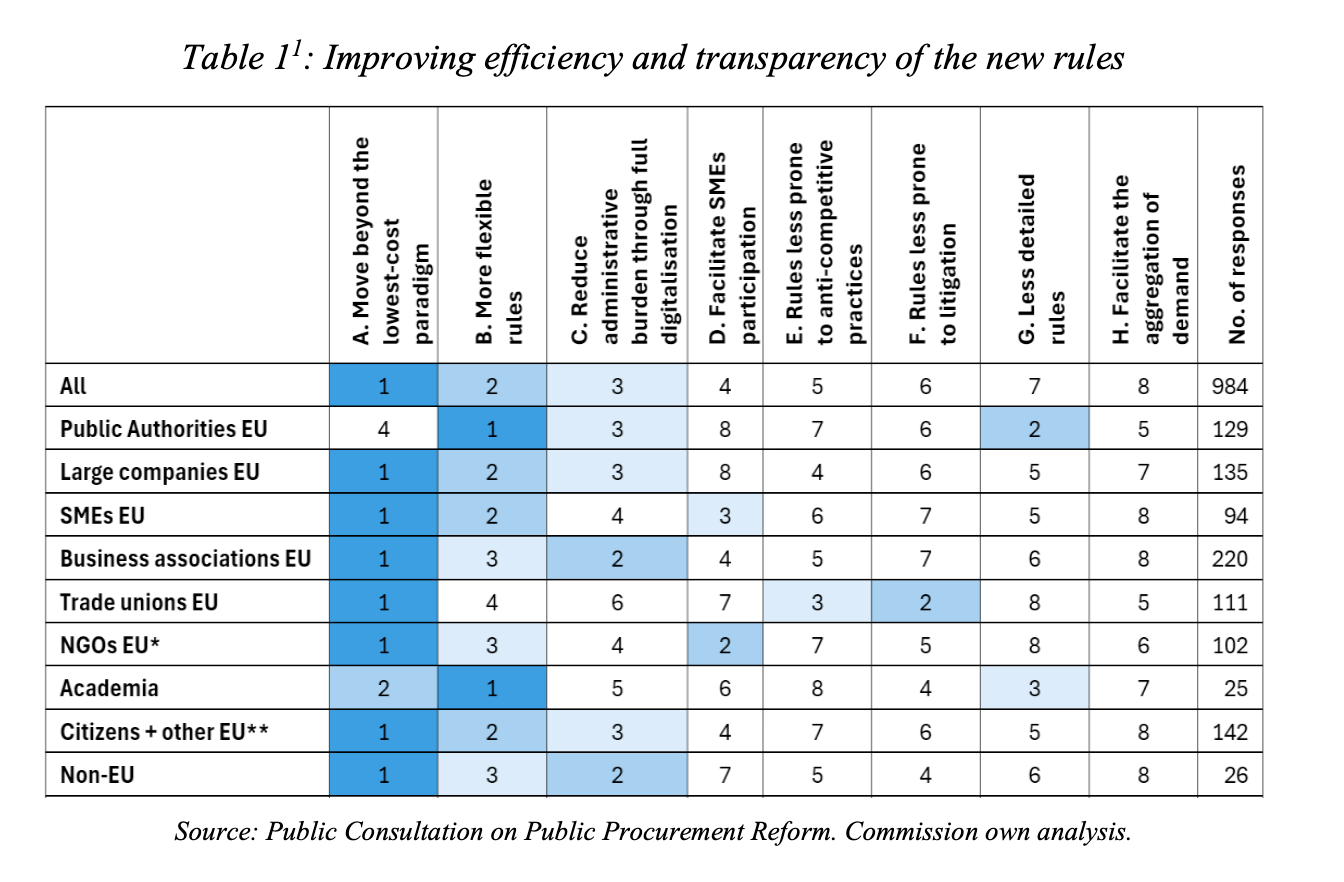
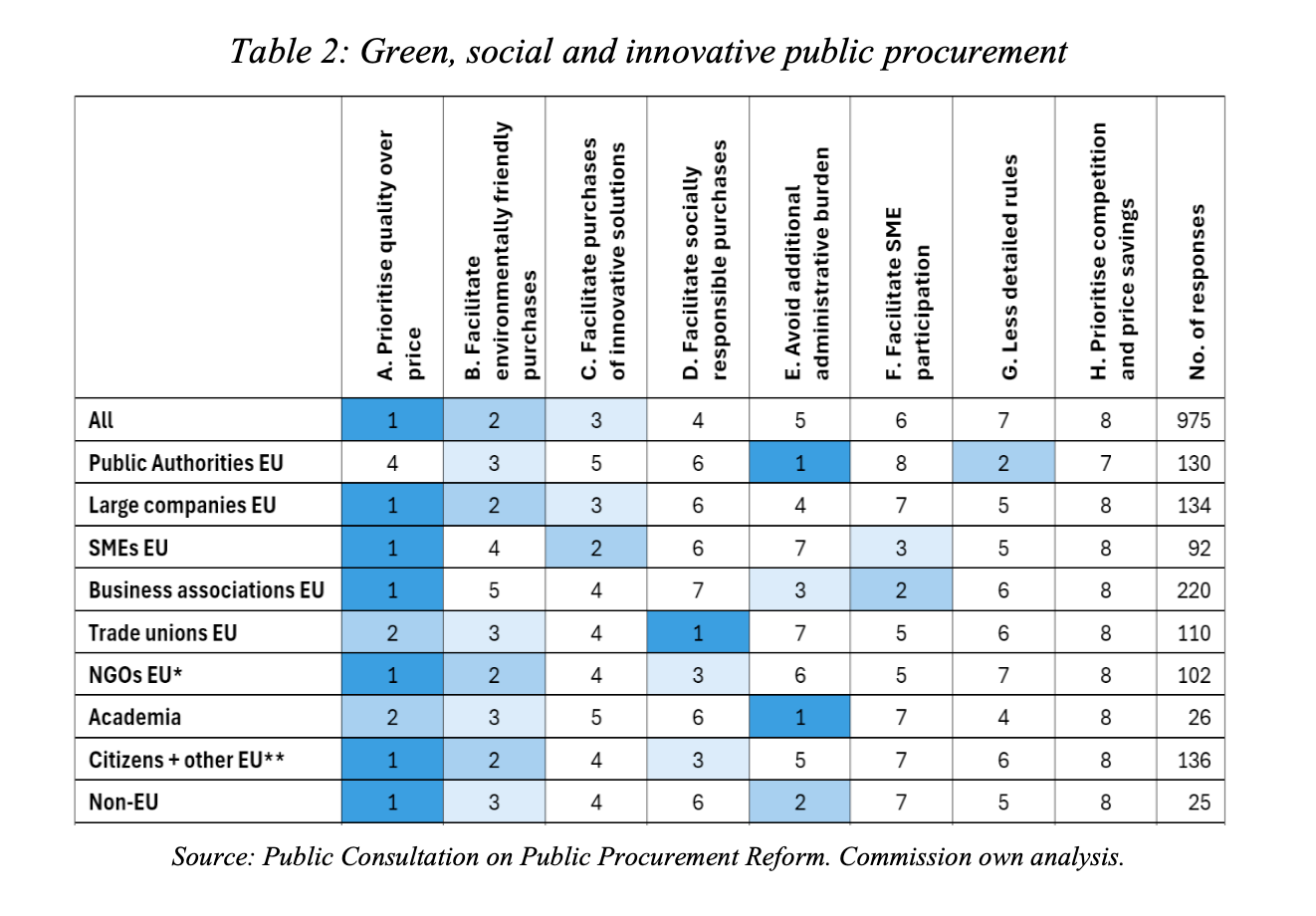
The first comment is the low participation rate to the consultation questions (below 1000), particularly in the public sector with 129 out of....250,000 contracting authorities. That is a participation rate of <0.5/1000, probably meaning that probably only the larger contracting authorities are represented here. If my assumption is correct then we need to look at their responses as coming from a subset of large contracting authorities and not contracting authorities overall. These are not representative numbers, something I have cautioned about when looking at the first consultation from early 2025 as well.
As for the answers, we can see that different stakeholders prioritise different things, and that there is a clear dichotomy between what these contracting authorities want and what the private sector (business associations, large companies and SMEs) are looking for from the revision.
Some of these differences illustrate to an extent what I have been saying for a long time, that is the current ruleset is broadly designed with the interests of economic operators in mind instead of the public sector. It is unsurprising that they are expressing very different priorities in here. For example, on table 1, private sector is fine with detailed rules since that in my view levels the playing field and constrains the contracting authorities worse impulses while the public sector respondents here do want less detailed rules and to avoid additional administrative burden. I shall remark that the same logic of more flexibility via less detailed rules was behind the creation of the innovation partnership which is the success we have all seen over the last decade. Detailed rules are good since they provide an 'operating system' or a 'painting by numbers' approach that allows individuals with lower skills to interface with public procurement from both sides. Taking that comfort blanket away increases risk and forces what is now settled in law to be decided on a case-by-case basis with the complexities it entails. More flexibility always carries the trade off of more complexity. It is not free!
As for the similarities, I would point out three. Everyone seems to want to move away from the lowest price, which is a view that I am definitely a contrarian about. What is likely as well this is due to different and maybe opposing reasons. Public sector wants the flexibility (but not the risk or liability associated) and private sector wants the opportunity to load and hide costs on quality so that margins go up. I am afraid that is the way the world works! The irony is that while the declared interest of the public sector here represented is to move away from lowest price, the revealed interest of the public sector behaviour overall is that lowest price is very sticky despite all the hoops to use it already in place in the legislation.
The second similarity is the low importance given to competition by respondents. It may be they think competition is a solved problem in public procurement (I don't think so)? Or that they are prioritising other interests and sacrifice competition to pursue them. If the latter is correct, then again I think both public and private sector are willing to trade competition off but for very different reasons. My views here are very old fashioned: we sacrifice competition and efficiency at our peril. Inevitably this will lead to more single bids, higher prices and, yes, potentially lower quality as well.
The last one is on "socially responsible purchases" from the second table. Other than the trade unions, no one else values it. At least it is clear here that this is an across the board view and not simply a contrarian opinion that can be easily branded as being reactionary.
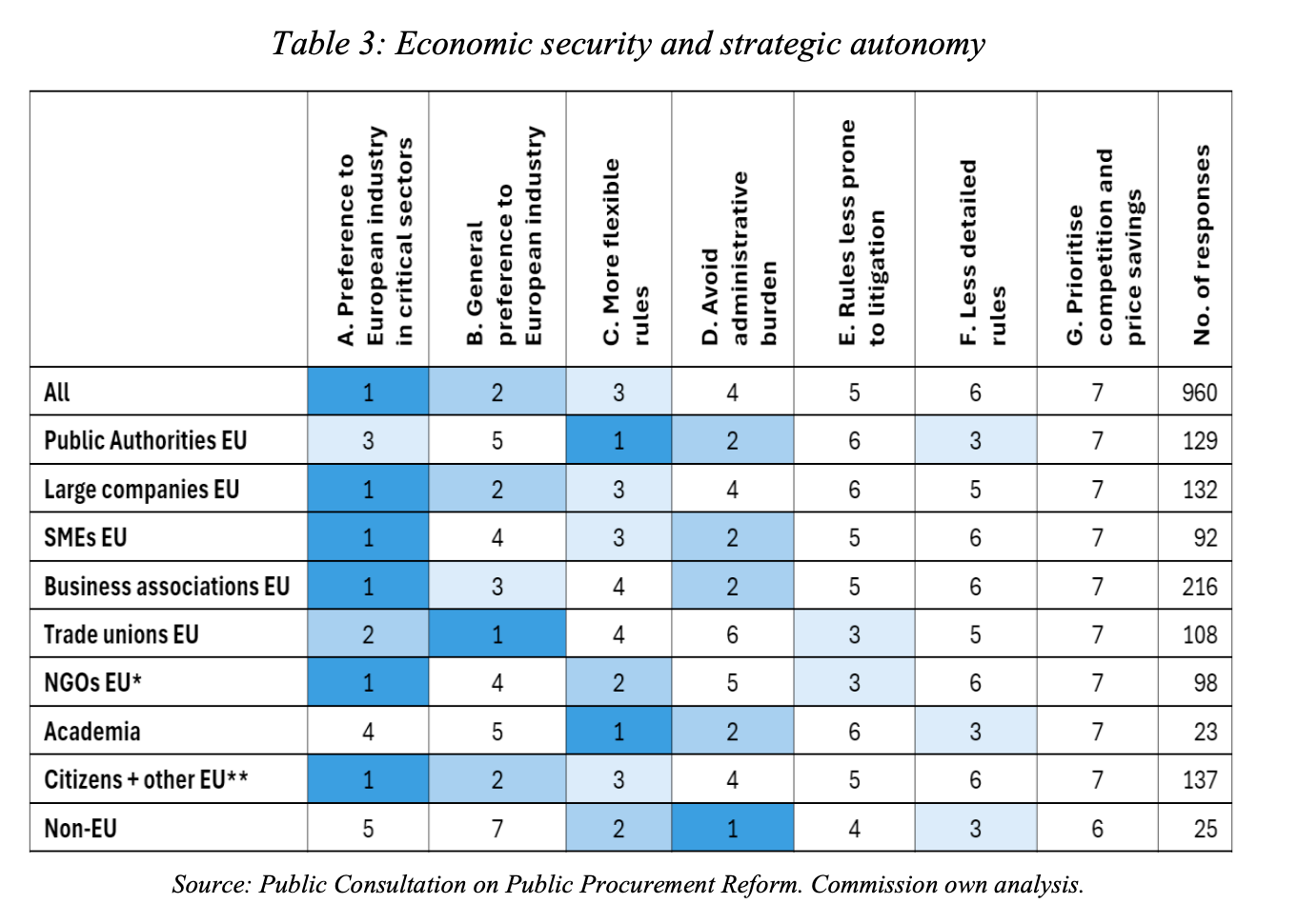
This third table also raises some interesting points. For European preferences in critical sectors, everyone seems to be in agreement, but from then on we can observe some splits in stated preferences.
For a general preference to European industry, larger companies rate it significantly higher than SMEs and that is no surprises since those are the companies most likely to be exposed to international competition. SMEs are more national by nature and in procurement deal with smaller contracts which, on aggregate, tend to be awarded more locally as well. On this, the public authorities who participated seem particularly cool about the whole idea. This is in line with the argument I made recently about the Innovation Accelerator Act, that in general this yet another strategic objective external to public procurement that is being brought in and not something contracting authorities have a particular interest or incentive in pursuing.
As for flexibility and administrative burden, public authorities once more would like to have flexibility but without administrative burden, something smaller companies agree with but the larger ones not so much.
Reducing the rules details is still reasonably valued by public authorities, but once again not at all by either large or smaller companies, something that was observed also on the previous tables.
As for the conclusion I would like to go back to the beginning and the caveat of (self-)participation rates really restricting the value and lessons one can take from the data presented here. I would add as well that if the questions were not rotated around or presented randomly there is a risk that the first few ones would lead to triggering an immediate higher preference by each individual respondent. This could explain why consistently across respondents and areas, questions A and B concentrate the majority of preferences 1 and 2.
After Easter I hope to return to the rest of the report.